

Anderson Gardens: A story within a story.

The original home of REI, now an established garden property with multiple homes forming a shared courtyard.
Architect: Rhodes Architecture + Light
Photography: Cheryl McIntosh
Read the architectural case study written by Architect, Tim Rhodes RA. AIA. Principal, Rhodes Architecture + Light.
I visited Anderson Gardens for Rhodes Architecture + Light in the fall of 2023, twenty years after the renovation of an existing farmhouse and addition of three new homes focused on a central garden, to see the greenspace and the architecture had grown into their role supporting a community. The story, however, begins much earlier.
"Originally, four lots were sold in May of 1925 as part of “Gatewood Gardens." In the years in between, this land made history. Rhodes Architecture + Light joined a group of neighbors, purchasing the original house and adjoining land in 2000 from Mary Anderson. From 1932, for seven decades, the land was a home, personal garden, and the place Mary, a teacher, and Lloyd Anderson, an engineer for the electrified Seattle trolley system, raised a family. Then, in 1938, Mary and her husband Lloyd started Recreational Equipment Incorporated (REI) in the little white house high above Lincoln Park in West Seattle, taking mail-orders for climbing gear for the cooperative. The attic was the REI warehouse, the basement an assembly line for tents and waterproof gear and REI’s first office, a room off the old kitchen.
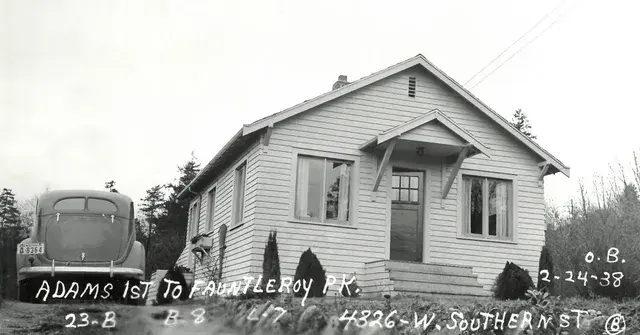
Same front exterior, but from 1938! The home was remodeled by architect Tim Rhodes when he purchased the home and land with a group in 2000.
When the Anderson home was renovated in 2000, the planning for the four lots included shared space-a shared entrance, drive and gardens; homes and garages that opened to become workshops surrounding common land dedicated to Lloyd + Mary Anderson. Each house occupied private, “fee-simple” land yet the experiment Rhodes Architecture + Light designed was centered on community and a large greenspace for play, gatherings and growing food, the land becoming the focal point. Three new houses were built two years later. Lloyd and Mary’s house maintains appropriate pride of place in its original elevated place above the garden." – Tim Rhodes RA. AIA. Principal, Rhodes Architecture + Light

A garden courtyard brings neighbors together shared appreciation for community and the life-sustaining land their homes rest on.
I arrived on site at 5:30PM, about two hours early. I knew it was going to be beautiful light that evening, and I wanted plenty of time to scout the property and identify the angles to focus on. It was a bonus if there were residents outside that I could talk to about their experience living here, and how they felt about the communal living environment. The goal was to capture how the landscape had evolved over twenty years, and to see what, if anything, the homeowners had made their own. What I found was a garden oasis and a community that had learned to adapt to, and even welcome, their unique hared living experience.

A bright Adirondack chair sat in a patch of sunlight on the small courtyard lawn, framed by flowers and lush plantings. It became my post as the most central place to watch the light shift as the sun sank toward Puget Sound. As residents pulled into the long, shared driveway after work, they caught sight of me and wandered over to chat, often tending the garden as they did. The pruning, the pulling of weeds, the picking of ripe cherry tomatoes, all felt as much a part of the conversation as the words exchanged. The common thread in our conversations was a shared love for their homes and the historic land they were built upon.


Residents spoke openly about the arc of twenty years of shared living. There had been friction along the way, the inevitable conflicts that arise when neighbors share more than a fence line. But they also shared that after two decades, they had arrived at something rare. Here was a mix of people who had genuinely embraced the lifestyle and formed close friendships deeply rooted in a sense of place. One resident painted a vivid picture of community spirit when he shared how Pearl Jam singer Eddie Vedder lives nearby, and that on practice nights, neighbors pull chairs into the courtyard to listen in. As he told it, warm evening light was filling the space around us, and I could almost hear the laughter of neighbors and see their sunlit glasses of Chardonnay in my mind's eye.
Although the focus of the visit was the interior courtyard, I was equally curious about the residents' experience inside their homes. The front facades face west toward Puget Sound, with large windows in the main living spaces oriented to capture the view. Seattleites rarely complain about the sun, and if they do, it usually starts out, "We are so grateful for the sun, but..." The residents noted that light reflecting off the water could be intense, and that specialty glass and blinds had helped mitigate it. But it was a trade-off every one of them was happy to make. The views were, by any measure, priceless.


As I moved through the property, I also noticed how the hardscaping such as sidewalks, railings, shared pathways, quietly reinforced the sense of connection between homes, creating a legible network that draws residents toward one another.

Each of the four homes is painted a different color within a bold, saturated palette of primary and secondary hues; a design choice that gives each residence a distinct identity without disrupting the cohesion of the whole. Beyond the courtyard, the homes have small private yards landscaped to feel continuous with one another and with the shared garden aesthetic. A koi pond near the original farmhouse technically belongs to one neighbor's yard, but functions as a community amenity, enjoyed by all. Positioned near the north end of the long driveway, the water feature provides both definition and design continuity to that edge of the property.

The homes share a modern farmhouse vernacular, but what makes Anderson Gardens architecturally distinctive is less about any individual structure and more about how the ensemble functions as a composition. These are relatively modest homes, and deliberately so.
"In addition to celebrating the history, Anderson Gardens was designed with the charge that smaller is better–the wellness of the community more important than scale and opulence. All interior spaces are greater close to plants and nature, and good daylighting abundant, which is crucial to the health and spirit of the residents." – Tim Rhodes RA. AIA. Principal

The home's entries, kitchens, and common areas are oriented inward toward the shared green, and the garages double as workshops that open onto the commons, quietly echoing the cooperative workshop spirit of REI's origin story.
Large sliding barn doors on the garages reinforce an agricultural vocabulary, while trellis and lattice screens woven through the site continue the handcrafted, workshop aesthetic that defines the whole. The image here is a simple one, but it made me want to return with my watercolors to capture the deeply peaceful energy it projected. There are images I take for the client, and images I capture for myself. This one belonged to both.

Finally came the shots I had been hoping for all evening. When the sunset finally spilled over the Puget Sound, it backlit the entire garden in a wash of amber and rose that sent chills. I positioned myself where the concrete path created a natural leading line through the frame, letting it pull the eye past the herb borders and dry-stacked stone, under the grapevine pergola, and deep into the layered garden beyond. The darkened garage facade on the right became an asset with its cool shadow anchoring the composition and throwing the warmth of the light into sharp relief. What strikes me most about the image above is how the architecture has receded. For a moment, Anderson Gardens is simply a garden, as alive and unscripted as any you might find in the countryside. That felt like the right note to end the evening on, but as the courtyard's twinkle lights came on, I extended my stay a few more minutes, hesitant to leave this magical setting.

My last image of the evening, a mailbox with its own stories to tell. I imagined the hands that so lovingly applied colorful tiles to the wall, and the decades of letters which frequented the box resting on its ledge. Times have changed since the first foundation was poured on this land. There may be fewer handwritten letters in the mail, but the love with which they were written flourishes in this special West Seattle community.

Thanks to Tim Rhodes and Rhodes Architecture + Light for allowing me to tell such a meaningful project story.

Comments